

Most buyers searching for a biothane dog leash manufacturer start with the wrong question. They ask "what's your price?" before they've defined what product they actually need. That gap — between what buyers ask and what they should ask — is where sourcing mistakes happen, and they're expensive ones.
Choosing a biothane dog leash manufacturer comes down to three things: material control, process transparency, and the ability to hold consistency across batch sizes. A manufacturer who sources their own biothane, walks you through the sampling workflow before you commit, and can explain what changes between a 100-unit and 1,000-unit run is demonstrably safer to work with than one who simply quotes the lowest price and says yes to everything.
There's more to unpack here. The sourcing mistakes buyers make are predictable — which means they're preventable. The sections below break down the specific questions you should be asking, and what the answers tell you about the manufacturer you're evaluating.
Is Biothane a Commodity Material You Can Source from Any Supplier?
Most buyers assume biothane is biothane. They see similar products, similar finishes, and assume the material is standardized. It isn't — and buying on that assumption is where quality problems start.
Biothane varies significantly by coating type, TPU layer thickness, substrate quality, and surface treatment1. Two leashes that look identical off the shelf can perform very differently in real conditions — one may stay flexible in cold weather while the other stiffens and cracks; one may hold its color after UV and water exposure while the other discolors within a season2.
Understanding this doesn't require a materials science background. It requires knowing which questions to ask — and what bad answers look like.
What Actually Varies Between Biothane Grades?
Here's a practical breakdown of the variables that matter for dog leashes specifically:
| Variable | Why It Matters | What to Ask |
|---|---|---|
| TPU coating thickness | Thin coatings peel faster, especially at hardware contact points | "What is your standard TPU layer thickness?" |
| Substrate webbing quality | Affects tensile strength and long-term shape retention | "What substrate do you use under the coating?" |
| Surface finish | Matte vs. gloss affects grip and scratch visibility | "Is the finish applied or inherent to the material?" |
| UV stability | Determines color fade over time in outdoor use | "How does this material perform after extended sun exposure?" |
| Flexibility in cold | Critical for markets like Canada, Scandinavia, or Northern Europe3 | "Does the material stiffen below 0°C?" |
In our experience, buyers who don't ask these questions before requesting a quote end up comparing prices on products that aren't actually equivalent. A quote for a leash using thin-coat biothane will always look better than one using a higher-grade material — until the returns start coming in4.
The Hardware Question Most Buyers Skip
Material grade isn't the only variable. Hardware selection matters just as much. A quality biothane leash paired with zinc alloy hardware that oxidizes in six months will still generate customer complaints5.
Ask your manufacturer:
- What hardware grades do you offer? (zinc alloy, solid brass, stainless steel)
- Which markets does each grade suit?
- Do you test hardware corrosion resistance?
A manufacturer with sourcing control over both the biothane and the hardware is in a much stronger position to hold product consistency. If they're buying hardware from a third party they can't audit, that's a risk worth noting.
What's the Right Order of Operations When Sourcing a Biothane Leash?
Most buyers come to us with pricing as their opening question. That's the wrong starting point — and it creates problems for both sides. When price comes first, everything else gets reverse-engineered to fit the budget, often at the expense of the product.
The correct sequence is: define the use case → specify the material grade and hardware → set your target retail positioning → then request quotes. Skipping steps one and two means you can't meaningfully compare quotes anyway, because you don't know if you're comparing equivalent products.
Here's how to think through this in practice.
Step 1: Define the Use Case
The use case determines everything downstream. A biothane leash marketed as a waterproof hiking leash has different requirements than one positioned as a stylish urban dog leash. Different target environments mean different material grades, hardware choices, and even packaging specs.
Ask yourself:
- Where will this product be used? (Water exposure? Cold climates? Heavy daily use?)
- Who is the end user? (Large dog owners? Small breed households?)
- What's the retail price point? (Budget tier vs. premium brand?)
Step 2: Specify Before You Quote
Once you know the use case, you can communicate it clearly to a manufacturer. A manufacturer who asks you these questions before giving you a price is a green flag. One who quotes immediately without asking is a yellow flag — they're either quoting a generic product or guessing.
The spec brief you bring to a manufacturer should include:
- Width: Typical leash widths are 1/2 inch, 3/4 inch, and 1 inch — each has a different feel and target dog size6
- Length: Standard, traffic leash, long line — each serves a different function
- Hardware material: Snap hook type, D-ring, handle hardware
- Coating preference: Matte, gloss, or specific finish
- Branding requirements: Debossed logo, heat stamp, printed label, or sewn tag
Step 3: Compare Quotes on Equal Footing
With a clear spec brief, manufacturer quotes become genuinely comparable. Without it, you're comparing apples and guesses.
How Do You Evaluate a Manufacturer's Custom Branding Capability?
Custom branding is where a lot of emerging brands underestimate complexity. Adding your logo to a biothane leash is not the same as uploading a file and pressing print. The process has real constraints — and a manufacturer who doesn't explain those constraints upfront is setting you up for delays.
A capable biothane leash manufacturer will walk you through the sampling workflow before you commit to an order. They'll tell you what branding methods are available for your chosen material, what the minimum commitment is for custom work, and how many rounds of sampling to expect before production approval. If they skip this conversation, ask for it explicitly.
Branding Methods and Their Constraints
Different branding methods suit different buyer needs. Here's a quick comparison:
| Branding Method | Best For | Limitations |
|---|---|---|
| Debossed logo | Clean, durable, premium look | Requires mold setup; single color |
| Heat stamp / foil stamp | Small runs, metallic finish | Limited surface area; pressure marks |
| Sewn woven label | Fabric tag feel; versatile | Adds cost; attachment point can fray |
| Printed label (adhesive or hang tag) | Budget option; full color | Less durable than embedded branding |
| Screen printing on leash body | Bold graphics | Requires flat surface; may crack on flex |
What to Ask About the Sampling Process
Before you confirm a custom order, ask the manufacturer these questions directly:
- How many sampling rounds are included before production?
- What is the lead time from sample confirmation to bulk production?
- Does the MOQ change with custom branding?
- Who absorbs the cost if a sample doesn't match the approved spec?
In our experience, buyers who treat custom sampling like an off-the-shelf order end up frustrated — not because manufacturers are careless, but because custom production has real variables that need to be resolved before bulk runs begin. A manufacturer who maps this out for you is saving you time and money.
Does MOQ Matter Differently Depending on Your Business Type?
Not all buyers have the same risk profile, and MOQ flexibility means different things depending on where you are in your brand's lifecycle. A first-time brand owner testing a new product SKU needs different things from a manufacturer than a distributor placing seasonal reorders.
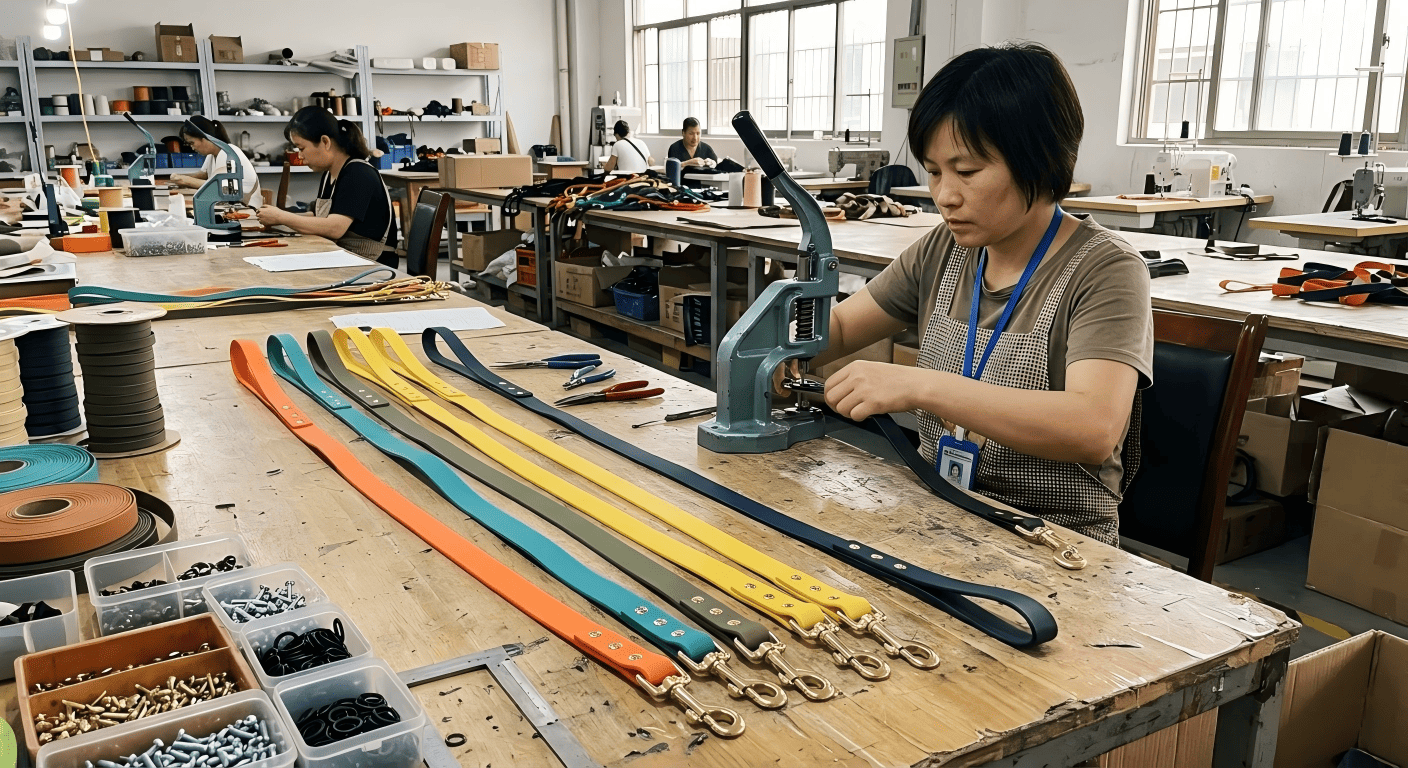
For emerging brands, flexible MOQ is a meaningful differentiator — but only if the manufacturer can hold batch consistency at small scale. A manufacturer who offers low MOQs but can't maintain color, hardware, or material consistency across runs creates a bigger problem: your customers receive different products, and your brand absorbs the confusion.
For New and Emerging Brands
If you're launching a new product, your first production run sets the expectation for every customer who buys it. Inconsistency at this stage is disproportionately damaging7.
What to look for:
- Does the manufacturer source their own biothane material? If yes, they have more control over consistency between runs.
- Can they show you samples from different batch dates? Color and texture should be visually consistent.
- What's the minimum run size where they can guarantee spec consistency?
A manufacturer with material sourcing control — rather than buying from a rotating pool of suppliers — is better positioned to hold consistency whether your order is 100 units or 5,000 units8.
For Distributors and Wholesalers
If you're placing larger seasonal orders, MOQ flexibility matters less. Consistency, lead time reliability, and communication speed matter more.
Ask about:
- Production scheduling windows — how far in advance do you need to book capacity?
- Lead time from order confirmation to shipment
- What causes delays in their production cycle?
A manufacturer who gives you honest answers about production constraints is more useful than one who promises whatever you want to hear.
Frequently Asked Questions
How do I know if a biothane leash manufacturer controls their own material sourcing?
Ask directly: "Do you source your biothane material from a fixed supplier, or does it vary by order?" A manufacturer with stable sourcing can usually name their material supplier or describe the material spec they use consistently. Vague answers here are a signal worth noting.
What's a realistic lead time for custom biothane dog leashes?
For standard styles with custom branding, expect 30–45 days from sample approval to bulk production shipment9. More complex customization — custom hardware, full-color printing, unique shapes — can extend this to 60 days or more. Always build sample review time into your launch schedule.
Can I order a single sample before committing to a bulk run?
Most manufacturers offer pre-production samples, though some charge a sample fee that is credited back against your bulk order10. Ask upfront whether the sample will be made from the same material grade and hardware as the bulk run — some manufacturers use higher-quality materials for samples.
What hardware grade should I specify for a premium biothane leash?
For premium-positioned products targeting European or North American markets, solid brass or stainless steel hardware is more appropriate than zinc alloy11. Zinc alloy is a viable cost-saving option for mid-tier products but is more prone to oxidation in wet environments.
How should I compare quotes from multiple biothane leash manufacturers?
Only compare quotes that specify the same material grade, hardware, branding method, and batch size. A quote that's 20% cheaper may reflect a different material spec rather than manufacturing efficiency. Send the same written spec brief to every manufacturer you're evaluating, then compare responses.
Conclusion
Finding the right biothane dog leash manufacturer isn't about finding the lowest price — it's about finding a supplier who reduces your sourcing risk. The buyers who make this process work well are the ones who arrive with a clear use case, a written spec brief, and the right questions about material grade, sampling workflow, and batch consistency.
If you're a brand owner testing a new SKU or a wholesaler building a reliable supply chain, the signals that matter are material sourcing control, process transparency, and honest communication about constraints. We manufacture biothane dog leashes, harnesses, and collars with direct material sourcing and full customization support — and we'd rather spend five minutes answering your spec questions upfront than fix a sampling problem three weeks into your launch timeline. Reach out and tell us what you're building.
"Frequently Asked Questions about BioThane", https://www.biothane.us/applications/animal/faqs/biothane-faqs/. Biothane refers to a class of thermoplastic polyurethane (TPU)-coated textile webbing in which performance characteristics — including flexibility, tensile strength, and surface durability — are determined by coating formulation, layer thickness, and substrate composition, none of which are governed by a single industry-wide standard. Evidence role: definition; source type: encyclopedia. Supports: That biothane is a category of TPU-coated webbing with variable material properties depending on formulation, coating thickness, and substrate selection rather than a single standardized material. Scope note: Biothane is a trademarked brand name (Biothane LLC) that has become genericized; material specifications vary by manufacturer and no universal standard defines grade classifications across the industry. ↩
"Observation of the Effect of Aging on the Structural ... - PMC", https://pmc.ncbi.nlm.nih.gov/articles/PMC10780686/. Research on thermoplastic polyurethane (TPU) coatings documents significant variation in cold-temperature flexibility and UV stability based on formulation and layer thickness, with lower-grade TPU films more susceptible to embrittlement below 0°C and accelerated surface discoloration under prolonged UV exposure. Evidence role: mechanism; source type: research. Supports: That TPU material properties govern cold-temperature flexibility and UV resistance, and that variation in formulation leads to differential performance outcomes. Scope note: General TPU materials research may not address coated textile webbing specifically; findings should be understood as mechanistic context rather than direct product-level proof. ↩
"U.S. Climate Normals", https://www.ncei.noaa.gov/products/land-based-station/us-climate-normals. Meteorological data from national agencies including Environment and Climate Change Canada and the European Centre for Medium-Range Weather Forecasts (ECMWF) confirm that Canada, Norway, Sweden, Finland, and Denmark regularly experience winter temperatures below 0°C, supporting the relevance of cold-temperature flexibility specifications for outdoor products sold in these markets. Evidence role: general_support; source type: government. Supports: That Canada, Scandinavia, and Northern Europe regularly experience sub-zero winter temperatures that would make cold-weather material flexibility a relevant product specification for outdoor pet accessories. Scope note: Temperature data establishes climatic context but does not directly measure consumer purchasing behavior or the frequency of outdoor dog walking in sub-zero conditions. ↩
"Systematic Review and Meta-Analysis of Quality Claims ...", https://pmc.ncbi.nlm.nih.gov/articles/PMC12784728/. E-commerce and supply chain research identifies product quality failures — including material defects and premature durability breakdown — as among the leading causes of consumer returns, with return rates in physical goods categories positively correlated with input material grade reductions. Evidence role: general_support; source type: research. Supports: That product quality level, particularly material durability, is a significant driver of consumer return rates and negative post-purchase outcomes in physical goods categories. Scope note: Published return rate data specific to pet accessories or biothane leashes is not publicly available; the cited relationship is supported by general consumer goods research rather than category-specific evidence. ↩
"Salt spray test", https://en.wikipedia.org/wiki/Salt_spray_test. Materials science literature and standardized salt spray testing (e.g., ASTM B117) document that zinc alloy components show accelerated surface oxidation and white rust formation under sustained moisture exposure, with performance falling below that of stainless steel and solid brass in corrosive environments. Evidence role: mechanism; source type: research. Supports: That zinc alloy hardware exhibits measurable corrosion degradation under wet or humid outdoor conditions, and that its corrosion resistance is inferior to stainless steel or solid brass alternatives. Scope note: Specific corrosion timelines depend heavily on coating quality, environmental salinity, and use patterns; the six-month figure cited in the article is illustrative rather than derived from a controlled study. ↩
"Width Recommendations - ForDogTrainers Blog", https://www.fordogtrainers.com/blog/width-recommendations/. Pet industry guidelines and veterinary handling recommendations consistently associate leash width with dog size and strength, with widths of 1/2 inch typically indicated for small breeds and widths of 1 inch or greater for large or high-pull dogs. Evidence role: general_support; source type: institution. Supports: That dog leash width selection is conventionally matched to dog size, with narrower widths suited to smaller breeds and wider widths to larger or stronger dogs. Scope note: Formal standardization of leash widths by dog size is not universally codified; recommendations vary across sources and no single authoritative standard governs this specification. ↩
"The Influence of Price on Purchase Intentions - PMC", https://pmc.ncbi.nlm.nih.gov/articles/PMC7911682/. Consumer behavior research on brand trust formation indicates that early product experiences establish quality expectations and brand schemas that are difficult to revise, making product inconsistency during initial market entry disproportionately harmful to long-term brand equity. Evidence role: mechanism; source type: research. Supports: That initial product experiences disproportionately shape consumer brand perceptions and that quality failures during early customer interactions are particularly damaging to brand trust formation. Scope note: Research on first-purchase effects is drawn from general consumer psychology and brand management literature; direct studies on physical pet product inconsistency and brand damage in the e-commerce context are sparse. ↩
"Quality in supply chains : an empirical analysis.", https://digitalcommons.usf.edu/former-pub/25/. Supply chain management research documents a positive relationship between supplier stability and output quality consistency, with single-source or preferred-supplier models reducing material variability that contributes to inter-batch defects and specification drift. Evidence role: mechanism; source type: research. Supports: That supplier consolidation and fixed sourcing relationships reduce input material variability and improve batch-to-batch product consistency in manufacturing contexts. Scope note: Most supply chain research addresses industrial or electronics manufacturing; direct evidence specific to small-batch textile or pet product manufacturing is limited, and findings should be understood as general mechanistic support. ↩
"Private Label Pet Supplies Manufacturers and Suppliers in ...", https://www.thomasnet.com/suppliers/usa/private-label-pet-supplies-95957908. Trade and sourcing industry references for OEM pet accessory manufacturing commonly cite production lead times of 30–60 days from approved sample to bulk shipment, with timelines extending for orders involving complex customization such as custom hardware or full-color printing. Evidence role: general_support; source type: institution. Supports: That OEM/custom manufacturing lead times for pet accessories from sample approval to bulk shipment typically fall within a 30–60 day range depending on complexity. Scope note: Lead times vary significantly by factory capacity, order volume, and seasonal demand; the figures cited are representative ranges rather than universal guarantees. ↩
"[PDF] THE COMPETITIVE IMPLICATIONS OF PRIVATE LABEL MERGERS", https://www.anderson.ucla.edu/documents/sites/faculty/strategy/schmitt/SchmittSmith_PrivateLabelMergers.pdf. Sourcing and trade industry references, including guidance published by bodies such as the Hong Kong Trade Development Council, document the sample fee with bulk-order credit as a standard commercial arrangement in OEM manufacturing, serving to offset sampling costs while incentivizing order commitment. Evidence role: general_support; source type: institution. Supports: That charging a sample fee credited against bulk orders is a recognized and common practice in OEM and private-label manufacturing, particularly among Chinese export manufacturers. Scope note: The prevalence of this practice varies by manufacturer, product category, and order scale; it is not a universal industry standard and terms differ substantially across suppliers. ↩
"7 High-Margin Pet Products to Import for the 2026 US & EU Markets", https://www.easygoglobal.com/articledetail/a-data-backed-sourcing-guide-7-high-margin-pet-products-to-import-for-the-2026-us-eu-markets. Industry and consumer product assessments in North American and European pet markets consistently associate stainless steel and solid brass hardware with premium positioning, owing to their superior corrosion resistance and longevity compared to zinc alloy alternatives. Evidence role: general_support; source type: institution. Supports: That stainless steel and solid brass are recognized as premium-tier hardware materials in pet product markets, associated with greater corrosion resistance and perceived quality. Scope note: Formal consumer preference data specific to dog leash hardware is limited; this claim reflects general market positioning conventions rather than published survey or sales data. ↩