
Starting a pet brand without a reliable manufacturer feels like a trap. You want custom products, but factories quote 500-unit minimums. You find a low MOQ dog harness manufacturer, but you're not sure if they can deliver a branded product consistently. Here's what actually matters before you place that first order.
Finding a low MOQ dog harness manufacturer doesn't mean settling for generic, unbranded goods. At our factory, we accept orders under 50 units per style and still support full custom branding — your logo, your labels, your colors. We produce dog harnesses, no-pull harnesses, leashes, and collars for brands in the US and Europe. Small batches are real orders here, handled with the same process as large ones.
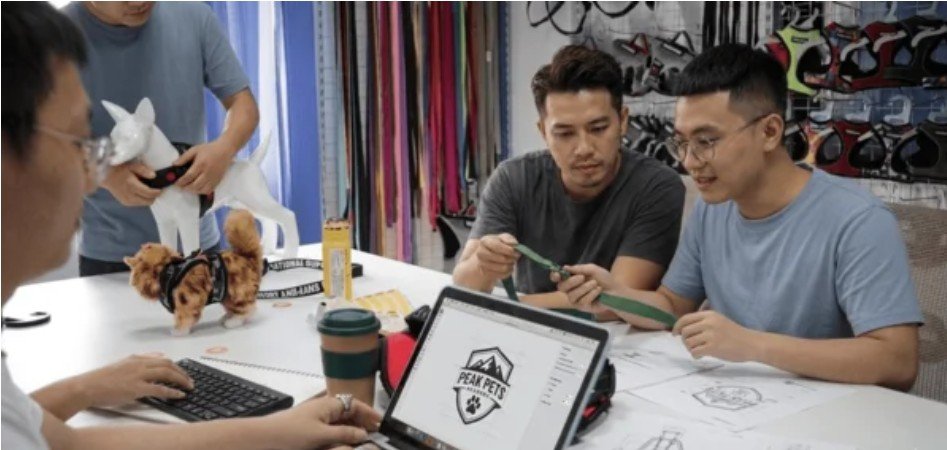
The catch most buyers don't anticipate is this: low MOQ is only half the answer. The other half is whether a small batch can actually come back branded, on-spec, and on time. The sections below break down exactly how that works — and where the real risks hide.
Can a Low MOQ Dog Harness Order Still Be Fully Branded?
Most boutique buyers and Shopify brand founders assume that custom branding requires bulk1. They settle for stock products with a hang tag slapped on. That's a missed opportunity — and it's also just not true anymore.
Even at quantities under 50 units per style, branding is fully achievable2. We support custom logo printing, woven labels, private label hang tags, and color-matched webbing. If you have existing design files, we work from those. If you don't have a design yet, we develop one for you.
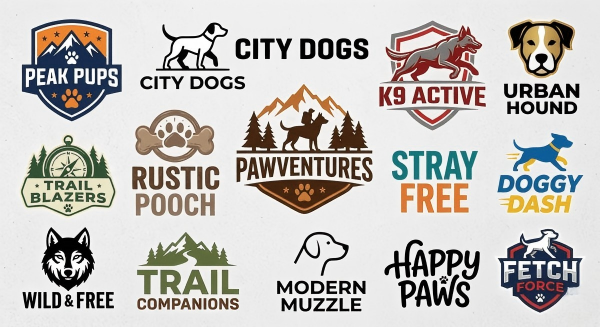
Here's what "fully branded" actually means in practice at small scale:
What Branding Options Are Available at Low MOQ?
When buyers come to us asking about low MOQ dog harness orders, branding is almost always the first question after price. Here's what's genuinely available — not as a upsell, but as a standard part of the process:
- Custom logo placement: Screen printing, heat transfer, or embroidery on the harness body3
- Woven label or printed label: Sewn into the harness, carrying your brand name and care instructions
- Private label hang tags: Your brand's card attached to each unit before shipping
- Color selection: Webbing, buckle color, and hardware finish can be matched to your brand palette
- Custom sizing range: You define the size run — not every size in every colorway needs to be in the first batch
OEM vs. ODM: Which One Do You Need?
This distinction matters because it changes how the order starts.
| OEM (Your Design) | ODM (We Design for You) | |
|---|---|---|
| You provide | Full design files or spec sheet | Product brief or reference image |
| We provide | Production to your specs | Design + production |
| Best for | Brands with an existing product vision | First-time product developers |
| Typical starting point | Sample from your files | Sample from our design |
| Branding | Your logo, your label | Your logo, your label |
Both paths support private label. The difference is who draws the spec sheet. Many of the Shopify brand founders we work with start with ODM because they haven't designed a harness before4 — they know their customer, but not the construction details. That's a legitimate starting point.
One honest note: ODM requires clear communication upfront about what the product must do — size range, closure type, chest girth support, intended dog breed profile5. A vague brief leads to a sample you'll reject. A specific brief leads to a sample you can refine and approve quickly.
Will the Unit Cost Kill Your Margin at Low MOQ?
This is the question most buyers are afraid to ask directly. The answer is: yes, small-batch unit costs are higher than bulk. That's not a secret. But framing it as a margin problem misses the actual math.
The real margin risk isn't the higher unit cost at launch — it's buying 300 units of a product your customers don't respond to6. Low MOQ protects you from that scenario7.
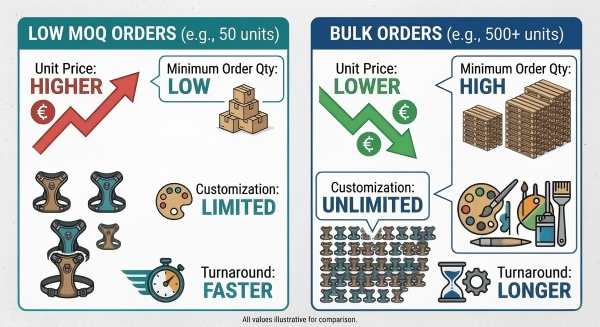
How Should You Think About Low MOQ Pricing?
Here's a realistic way to structure your thinking:
The cost you're comparing:
- Low MOQ (under 50 units): higher per-unit cost
- Bulk order (200–500 units): lower per-unit cost
The risk you're not comparing:
- Low MOQ: limited capital tied up, product can be tested before scale
- Bulk: lower unit cost, but full inventory exposure if the product doesn't sell
The question isn't "can I afford the higher unit cost?" — it's "how much inventory am I willing to risk on an untested SKU?"
For a new product or a new size variation, starting with 30–50 units lets you validate the design, check the fit feedback from real customers, and confirm reorder potential before committing. That's not an inefficient use of your budget. It's the lowest-risk path to a profitable SKU.
What's the Price Difference Actually Like?
We don't publish a price list here because it depends on design complexity, hardware spec, branding method, and size range. What I can tell you is what drives cost up at low quantities:
- Setup costs don't scale down. Sewing patterns, label setup, and sample confirmation take roughly the same time whether we make 30 units or 300. Those fixed costs spread thinner over larger runs.
- Webbing and hardware minimums. Some materials have supplier minimums. For small runs, we absorb partial rolls — that's reflected in the unit price.
- Branding setup fees. Screen printing screens or embroidery digitizing are one-time charges. At low MOQ, they represent a larger share of your total order cost.
Understanding these cost drivers helps you negotiate more precisely and plan your pricing model from the start — not after you've already placed an order.
How Do Low MOQ Dog Harness Factories Handle Quality Consistency?
Delivery reliability is the top concern I hear from buyers sourcing at small scale. The specific fear sounds like this: "The sample was great. Then the actual order came back different."
That's a real problem. And it usually traces to one failure point: the sample-to-production handoff was never properly confirmed in writing.
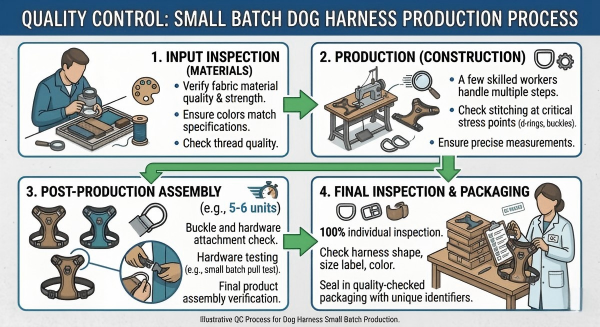
What Does the Confirmation Process Look Like for Small Orders?
For orders under 50 units, our process works like this:
- Pre-production sample: We produce a sample from your confirmed spec sheet. You review and approve — or request changes.
- Spec lock: Once you approve the sample, all dimensions, materials, hardware, and branding elements are locked in writing. This is the document production runs against.
- In-production check: During stitching and assembly, our QC team checks against the locked spec. Harness hardware, stitching tension, label placement, and sizing are all part of that check8.
- Pre-shipment photos: Before packing, we photograph finished units and share them with you. This gives you a final visual confirmation before goods leave the factory.
This process doesn't change based on order size. A 30-unit run goes through the same steps as a 300-unit run. The only difference is the volume at each step.
Why Does Export History Matter for a Small Brand?
Buyers sometimes ask why it matters that we ship to the US and Europe. Here's the practical reason: those markets have import compliance requirements — product labeling, material restrictions, and hardware safety standards9. Shipping to those markets regularly means we're already producing to those expectations by default.
That matters for a small brand because you're not going to have the leverage to audit a factory yourself. Export history to regulated markets is an indirect signal that production standards aren't negotiable — regardless of order size10.
We're not making certification claims here. What I'm saying is: if a factory has never shipped a harness to the US or EU, ask why. The answer matters.
Frequently Asked Questions
What is the minimum order quantity for a custom dog harness?
We accept orders starting at under 50 units per style. Exact minimums depend on the design complexity and branding requirements. Reach out with your product brief and we'll confirm the minimum for your specific configuration — we don't apply a single fixed number to every order.
Can I use my own brand logo on a small-batch dog harness order?
Yes. Custom logo application is available even at low MOQ. Options include woven labels, printed labels, heat transfer, or embroidery on the harness itself. You can supply your logo files, and we handle production and placement according to your spec.
How long does it take to get a sample before production?
Sample lead time is typically 7–14 days after your design is confirmed11 and the spec sheet is approved. Production lead time after sample approval depends on order size and current schedule — for small batches, it's generally shorter than bulk runs.
What's the difference between OEM and ODM for dog harnesses?
OEM means you supply the design and we manufacture to your spec. ODM means we develop the design based on your brief. Both options support private label branding. ODM is a practical choice if you don't have a technical design background but have a clear product concept.
Do you ship dog harnesses to the US and Europe?
Yes. We have export history shipping to both the US and European markets. We're familiar with the labeling and compliance expectations those markets require and factor them into production by default.
Conclusion
A low MOQ dog harness manufacturer can deliver a branded, export-quality product at small scale — but only if the factory's process supports it from sample through shipment. The real questions to ask aren't just about price or minimum quantities. Ask about the sample confirmation process, branding options at your target volume, and where the factory already ships to. Those answers tell you more than any MOQ number alone.
If you're building a pet brand and want to test a harness line before scaling, we're set up for exactly that — custom design, private label branding, and a production process that doesn't cut corners because your batch is small.
Get in touch with your product brief. We'll confirm what's possible for your specific order.
"5 Myths and Facts About Private Label Products - Entrepreneur", https://www.entrepreneur.com/starting-a-business/5-myths-and-facts-about-private-label-products/371023. Studies on small and medium enterprise internationalization and sourcing behavior document information asymmetries between small buyers and contract manufacturers, with small brand founders often underestimating the customization options available at low volumes due to limited direct sourcing experience and reliance on anecdotal peer information. Evidence role: general_support; source type: research. Supports: That small business owners and e-commerce entrepreneurs frequently misunderstand the capabilities of low-MOQ contract manufacturers, including availability of branding services at small scale. Scope note: Direct survey data quantifying the specific misconception that branding requires bulk order quantities among pet brand founders or Shopify merchants is not available in published academic literature; the claim is supported by broader SME sourcing behavior research. ↩
"Private Labeling Products – Custom Branding, White ...", https://www.trendsi.com/feature/private-labeling-products/?srsltid=AfmBOopEvXluqiKNX2E_OqfwvNNPY1KMzFWQgK4dlDxItd22yWmw5CHV. Research on small-batch contract manufacturing indicates that setup costs for branding processes such as embroidery digitizing and screen printing are largely fixed, meaning branding is technically executable at low volumes, though per-unit costs increase as fixed costs are distributed across fewer units. Evidence role: general_support; source type: research. Supports: That private label branding options such as woven labels, custom printing, and color matching are technically feasible at small production runs in contract manufacturing. Scope note: General contract manufacturing literature may not address pet product or dog harness manufacturing specifically; direct industry benchmarks for sub-50-unit MOQ branding are limited in published research. ↩
"Screen Printing vs. Embroidery vs. Heat Transfer: Which Is Right for You?", https://www.epromos.com/blog/screen-printing-vs-embroidery-vs-heat-transfer/?srsltid=AfmBOoq7IazHFnO_ct2d-DqEMobWgZ-xr_ahp7racjb71IZdONv7rsiw. Textile decoration literature distinguishes screen printing, heat transfer, and embroidery by substrate compatibility, wash durability, and setup cost structure; embroidery digitizing and screen printing screens represent fixed one-time costs that become proportionally more significant at lower production volumes. Evidence role: mechanism; source type: education. Supports: The technical distinctions among screen printing, heat transfer, and embroidery as logo application methods, including their relative setup costs and suitability for woven textile substrates. Scope note: Published sources typically address apparel rather than pet harness webbing specifically; material behavior may differ on nylon or polyester harness webbing compared to garment fabrics. ↩
"What is ODM vs OEM? Manufacturing Models Explained for Businesses", https://www.sourcy.ai/blogs/what-is-odm-oem. Research on small and medium-sized e-commerce enterprises documents a pattern in which brand founders with marketing and customer insight competencies but limited technical manufacturing knowledge rely on ODM partnerships to translate product concepts into manufacturable specifications, outsourcing design development to the factory while retaining branding and market positioning decisions. Evidence role: general_support; source type: research. Supports: That small e-commerce entrepreneurs frequently lack product design expertise and rely on ODM or manufacturer-led development as a practical path to private label products. Scope note: Peer-reviewed studies specifically quantifying ODM adoption rates among Shopify or DTC pet brand founders are not available; the claim is supported by broader e-commerce entrepreneurship literature rather than direct industry data. ↩
"Design Brief – From Concept to Reality", https://www.lean.org/the-lean-post/articles/from-concept-to-reality/. New product development research consistently identifies incomplete or ambiguous design specifications as a primary cause of rework, sample rejection, and cost overruns in contract manufacturing relationships; detailed functional briefs that specify performance requirements, dimensional tolerances, and material constraints are associated with shorter development cycles and higher first-sample acceptance rates. Evidence role: general_support; source type: research. Supports: That detailed and specific design briefs or product specifications improve outcomes in ODM and contract manufacturing, reducing sample rejection rates. Scope note: Published research on design brief quality typically addresses broader product development contexts; specific studies on pet accessory ODM manufacturing are not widely available in peer-reviewed literature. ↩
"How Small Manufacturers Can Develop Risk Management ...", https://www.nist.gov/feature-stories/how-small-manufacturers-can-develop-risk-management-strategies-their-supply-chains. Operations management and lean manufacturing literature identifies demand uncertainty as a primary driver of inventory risk, noting that producing in smaller batches aligned with validated demand reduces the cost of unsold stock, even when per-unit production costs are higher. Evidence role: general_support; source type: research. Supports: That excess inventory from untested product launches constitutes a significant financial risk for small brands and that small-batch production reduces this exposure. Scope note: Published lean inventory research often originates from manufacturing or retail contexts broader than direct-to-consumer pet product brands; applicability to very small Shopify-scale operations is contextual rather than directly demonstrated. ↩
"What Is an MVP? Eric Ries Explains", https://leanstartup.co/resources/articles/what-is-an-mvp/. Lean startup methodology and agile product development frameworks advocate for minimum viable production runs as a mechanism to test market response before scaling investment; this approach is documented in entrepreneurship literature as reducing the risk of overproduction in contexts of high demand uncertainty, which is characteristic of new product launches. Evidence role: general_support; source type: research. Supports: That small initial production runs allow new brands to validate market demand before committing to large inventory positions, reducing financial exposure from untested SKUs. Scope note: Lean startup literature primarily addresses software and technology product development; application to physical goods manufacturing involves additional constraints such as material minimums and setup costs that the framework does not fully address. ↩
"Dog Harness Quality Control: What Pet Brands Should Check Before ...", https://www.minardipets.com/dog-harness-quality-control.html. Quality assurance protocols for sewn textile accessories and restraint equipment typically encompass seam strength and stitching density, hardware load-bearing capacity, dimensional conformance to size specifications, and labeling accuracy; these parameters correspond to both functional safety and regulatory labeling requirements applicable to products sold in the US and EU markets. Evidence role: definition; source type: institution. Supports: That quality assurance for sewn pet restraint products such as harnesses involves inspection of structural elements including stitching integrity, hardware function, and dimensional conformance to specification. Scope note: Mandatory product safety standards specifically for dog harnesses as a distinct category are not universally codified; inspection criteria cited in the article reflect common manufacturing practice rather than a single published standard. ↩
"Importing - Animal Food", https://www.fda.gov/animal-veterinary/import-exports/importing-animal-food. U.S. Customs and Border Protection and the Consumer Product Safety Commission establish import compliance requirements for consumer goods including pet accessories, encompassing country-of-origin labeling, restricted substance compliance (e.g., REACH in the EU), and product safety standards; the EU's General Product Safety Directive and REACH regulation similarly constrain materials and require documentation for goods placed on the European market. Evidence role: historical_context; source type: government. Supports: That the United States and European Union impose regulatory requirements on imported pet products, including material safety, labeling content, and hardware standards. Scope note: Specific mandatory safety standards for dog harnesses as a distinct product category may not be separately codified; general consumer product and textile regulations typically apply by extension. ↩
"Supplier Qualification In GMP - What Do You Need To Consider?", https://gmpinsiders.com/supplier-qualification-in-gmp/. Supply chain management literature on supplier qualification notes that demonstrated compliance with regulated export markets — including documentation requirements, restricted substance compliance, and product safety standards — can serve as a credible proxy for process discipline in the absence of buyer-conducted audits, particularly for small buyers without audit leverage. Evidence role: general_support; source type: research. Supports: That export history to markets with strict regulatory requirements can serve as an indirect quality and compliance signal when direct factory auditing is not feasible. Scope note: Export history is an imperfect proxy; a factory may export to regulated markets for some product lines while maintaining inconsistent standards for others; direct audit or third-party certification remains the more reliable indicator. ↩
"Types of garment samples during apparel production", https://techpacker.com/blog/manufacturing/12-types-of-garment-samples-you-should-know-about-for-apparel-production/. Industry sourcing guides and trade association resources for sewn goods manufacturing commonly cite pre-production sample turnaround times of one to three weeks depending on design complexity, material availability, and factory workload, with simpler constructions trending toward the lower end of that range. Evidence role: general_support; source type: institution. Supports: That pre-production sampling in sewn goods or accessories manufacturing commonly falls within a 7–14 day window following design confirmation. Scope note: Published benchmarks for sample lead times vary considerably by product category, factory location, and capacity; the 7–14 day figure cited in the article reflects a specific factory's current schedule rather than a universal industry standard. ↩